Tag Archives: cactus

What’s in a Botanic Name?

Have you ever wondered what the long, Latin(ish), unpronounceable names are that you see on every label of a plant? Are they important? What do they mean? Here’s the short story on a somewhat long explanation.

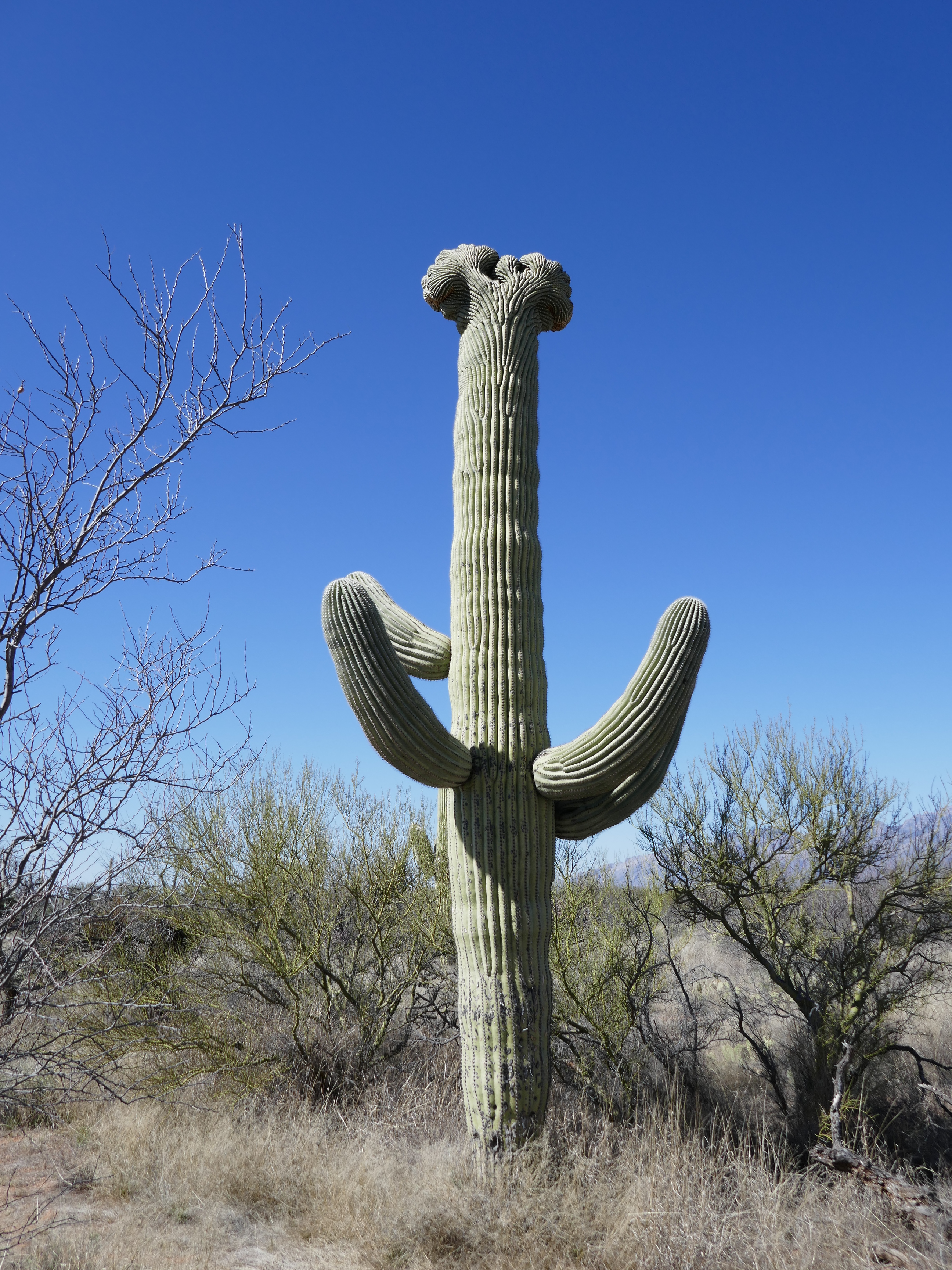
Let’s first take a look at the two names that are associated with every plant out there (yes, every single plant on the planet has a unique botanical name). Botanical names are usually made up of two words. The first word (always capitalized) is the bigger group (genus) that a plant belongs to. Take the cactus which all belong to the family group, Cactaceae. The second word (never capitalized) relates to the specific plant. So, Carnegiea gigantea refers to the cactus known as the saguaro. Notice the botanic name is italicized and by the “rules” it should also be underlined, but this is not always practiced.

Saguaro in Catalina State Park
Carnegiea gigantea

So, if Carnegiea is the name for cactus, what other families are out there? (In honor of this being the letter B in the A to Z blogging challenge, these are a few that start with the letter B):

  • Baileya multiradiata, Desert Marigold
  • Berlandiera lyrata, Chocolate Flower (a must have in every desert garden – it smells like chocolate!)
  • Brandegea bigelovii, Desert Starvine

But what do these designations signify? While a comprehensive exploration exceeds the scope of this discourse, let’s unravel a couple of examples. Consider Berlandiera lyrata, where “lyrata” hints at its leaf shape reminiscent of a lyre, while “multiradiata” aptly describes its profusion of rays, a characteristic trait of marigolds. Furthermore, “gigantea” in Carnegiea gigantea evokes the colossal stature of the saguaro, befitting its towering presence in the desert landscape.

Is the botanical name important? YES! Can you just go to the store and ask for a Texas Ranger? NO! I answer these questions in all caps because I experienced this first hand. When I moved to our home here in Tucson, I was busy at the local garden centers filling my half acre yard with desert dwelling plants. In one area I put in three Texas Rangers. These were to grow to 6′ to 8′ in height and width. The size is perfect for the spot I put them in. One problem cropped up though. I planted the three with a giant hole between plant #1 and #2 so I needed one more Texas Ranger to fill the gap. I went back to the nursery not realizing that not every Texas Ranger is the same. I grabbed one that turned out to be a different species that only grows to 4′ and is a different color. There are about 10 different species of Texas Ranger so my next trip to the garden center I went armed with the botanical name; Leucophyllum pruinosum, not Leucophyllum maygophullum.

Next time you are looking at a new plant, get to know the botanical name. You may never remember it, but it is what sets each plant apart from another.

If you have had any plant foibles I’d love to hear about them. Leave your story in the comments.
Until then,
Happy Gardening!!


This post was brought to you by the letter B and written specially for the 2024 A to Z blogging challenge.
#AtoZChallenge 2024 badge B

2 Comments

Filed under Arbitrary Thoughts, Gardening, Plants

Master Gardener – Part 2

There’s a really good reason I have failed miserably to keep you all up to date on my progress through the Master Gardener program. There is just too much information to compact it into a blog post! It is incredible what we have been learning. (I will admit some of it goes way over my head, and I hope that once I enter the year long internship program, a lot of this will start to make sense.)

So, what have we studied so far in the last 7 weeks? Botany, soil, fertilizers, irrigation, propagation, entomology, and Integrated Pest Management (no pesticides needed!). Now that we have the bare bones of how plants and insects live together, we are now diving into the different plants themselves. Next up – cactus, succulents and Xeriscape.

Cactus are a whole new world for me. After living in Colorado for 40+ years I never grew any. They were too pokey in my gardening handbook. Don’t get me wrong, Colorado is semi-arid so there were cactus there, just not like they are here in Arizona. Now, after living in Arizona for only two years, those prickly critters are growing on me. Respect is the word I’d use. After all, living in a desert environment is only for the tough at heart. Nearly everything here will either stab you, sting you, or bite you so if you want to survive you better be able to stand the heat (literally and figuratively).

With all that said, I want to rephrase my commitment to you. Instead of a weekly post about, “What I learned in school,” I will, instead, share gardening tips along the way. If something pops up during class that could be of interest, or is one of those “fun facts’ I’ll share it with you.

So, until next time remember this:
Every part of the prickly pear is either useful (the thorns can be used as a needle) or edible (the pads as well as the fruit – have you had prickly pear jelly? Delish!).

Leave a comment

Filed under Gardening

Desert Gardening

In the vast expanse of arid landscapes, such as the Sonoran Desert or the Mojave Desert, where the scorching sun dominates and water is a scarce resource, lies a fascinating and rewarding pursuit—desert gardening. Contrary to popular belief, desert regions offer unique opportunities for cultivating vibrant and sustainable gardens that thrive in extreme conditions. With careful planning, resource management, and an understanding of desert ecology, anyone living in the desert can create an oasis of greenery amidst the desert’s harsh realities. Let’s explore the art of desert gardening, highlighting its benefits, essential techniques, and some plant choices that will transform your perception of what’s possible in a barren land.

Here are a few things you should understand before getting started:

  • Understand the Desert Environment
    Before embarking on a desert gardening journey, it is crucial to comprehend the unique characteristics of this environment. Deserts are known for their low rainfall, intense sunlight, high temperatures, and poor, well-drained soil. However, deserts also possess a rich ecosystem adapted to these challenging conditions, offering inspiration and guidance for gardeners. By observing the native plant species and their survival strategies, we can gain valuable insights into which plants thrive in these extreme climates. Remember, desert environments can range from freezing temperatures to high heat so be aware what your micro-climate might be.
  • Efficient Water Management
    Water scarcity is the biggest challenge in desert gardening. To overcome this obstacle, gardeners must focus on water conservation and efficient irrigation techniques. Collecting and storing rainwater through rain barrels or cisterns can provide a valuable resource during dry spells. Additionally, implementing drip irrigation systems, and using mulch to retain moisture are effective methods to minimize water loss and maintain soil hydration. Using passive water systems which combine berms with swales will make any rains efficient in watering your garden. Grouping plants with similar water needs together and practicing xeriscaping (a landscaping method that reduces water usage) can further optimize water usage in desert gardens.
  • Soil Improvement
    Desert soils are often low in organic matter and lacking in essential nutrients. Enhancing the soil’s quality is crucial to support plant growth in these harsh conditions. Incorporating compost, organic matter, and well-balanced fertilizers can significantly improve soil structure, water-holding capacity, and nutrient availability. Amending the soil with materials like perlite or vermiculite can also enhance drainage and prevent waterlogging, which is detrimental to desert plants. Keep in mind that some plants are happy living in the unenhanced soil found in the desert so don’t overdo it.
  • Plant Selection
    Choosing the right plants is fundamental to successful desert gardening. Native species that are adapted to the arid environment are the ideal choice, as they have evolved to withstand the harsh conditions. These plants have developed unique features like succulent leaves, water-storing stems, or deep root systems that help them conserve water. Examples of popular desert plants include cactus (golden barrel, prickly pear, or Mexican Fence Posts), succulents (such as agave and aloe vera), desert marigold, desert lavender, and desert milkweed. It’s important to consider factors such as sun exposure, cold tolerance, and water requirements when selecting plants for a desert garden.
  • Creating Microclimates
    In the desert, temperature extremes can be challenging for plants. Creating microclimates within your garden can help protect sensitive plants from excessive heat or cold. Using shade structures, such as pergolas or shade cloth, can provide relief from intense sunlight during the hottest part of the day. Planting taller, heat-tolerant species strategically to provide shade for more delicate plants can also be beneficial. Additionally, windbreaks made of fences or hedgerows can shield plants from strong desert winds, reducing water loss and preventing damage.

Desert gardening celebrates nature’s resilience and showcases the incredible adaptability of plant life. By embracing the unique challenges of the arid environment and employing smart gardening techniques, you can create lush and sustainable gardens that thrive in the face of adversity. Through efficient water management, soil improvement, careful plant selection, and the creation of microclimates, desert gardeners can transform barren landscapes into vibrant oases, inspiring others to appreciate the beauty and diversity of desert flora. So, if you’re ready to embark on an extraordinary gardening adventure, the desert awaits you with open arms and the promise of a flourishing paradise.

Leave a comment

Filed under Gardening, Plants

Cactus

A couple of years ago we moved to the Tucson area where the cactus grow tall and their needles are in Mother Nature’s sewing kit to pierce heavy leather. Saguaro (Carnegiea gigantea) are the world’s largest cactus so we’ll dedicate this post them. These gentle giants of the desert are amazing. Not only do they grow to 40 feet tall, but they also have arms that can curl around to look like a hug, or even a chair. Be aware though, if you sit on one you will never sit anywhere else for quite sometime. Their two inch needles will leave you with many holes in your backside.

Here are a few fun facts about the saguaro:

  • Saguaro is pronounced suh-waa-row.
  • They grow slowly. Only about 1-2″ per year.
  • When fully hydrated a mature cactus can weigh 3,200 – 4,800 pounds
  • The root system is pretty shallow (5-6 inches deep), but it stretches outward as far as the plant is tall. It does have a single tap root that will extend into the ground a few feet. Considering how tall these gentle giants are, that’s not very deep.
  • The woody skeleton can be used to thatch a roof, build a fence, or furniture parts.
  • “Saguaro Boots” (holes that birds built their nests) can be used as a water container.
  • A saguaro can have anywhere from zero arms to over 25 and usually curve upward.

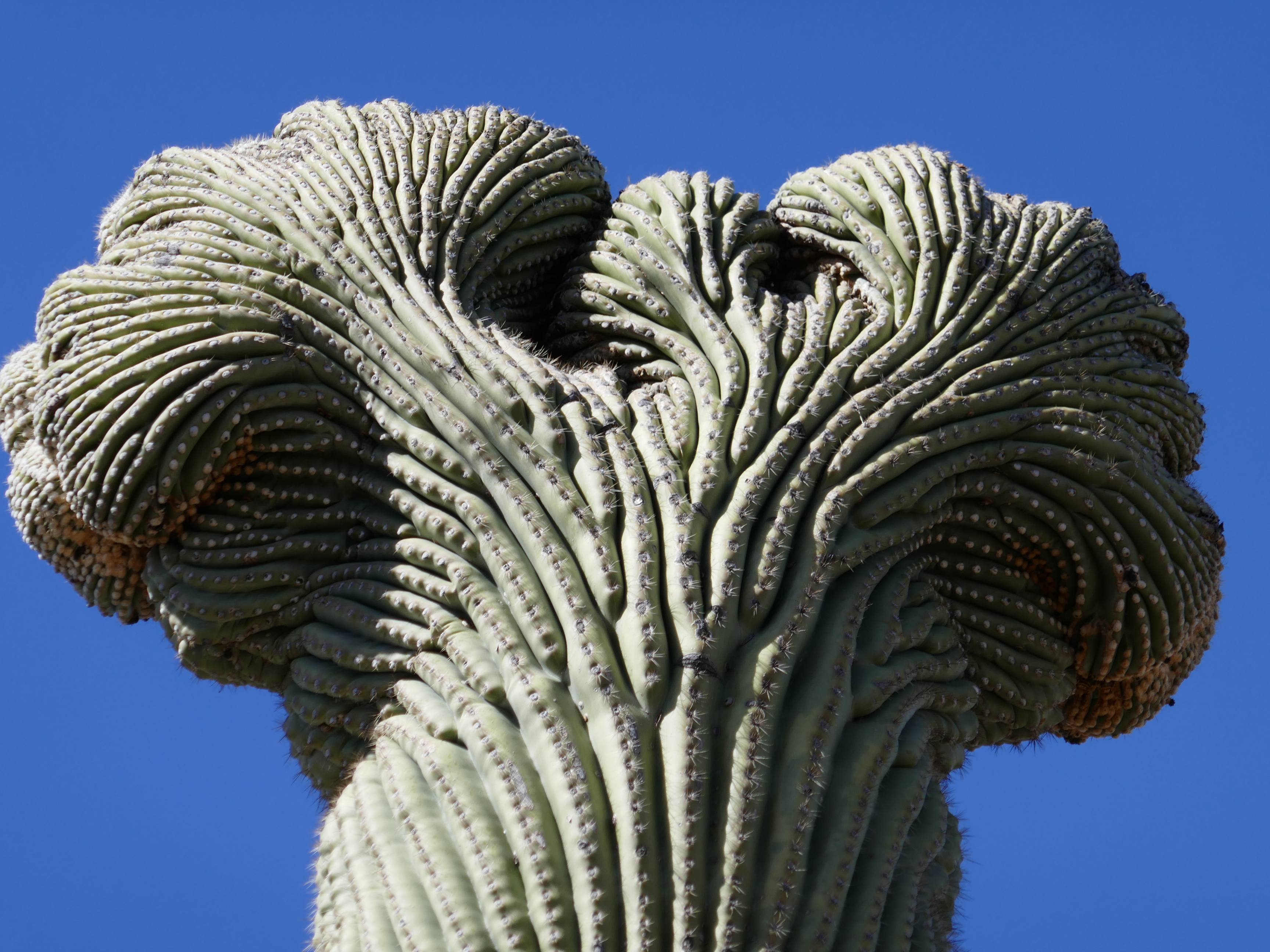
One particular saguaro that I love to see is the crested saguaro. This is something that a few saguaro like to do, but not all. It is unclear why this happens but every now and again a saguaro’s growing tip (that’s the top) produces a fan like form. They are somewhat rare, and there are a few “hunters” who have spent years documenting and counting these amazing cactus. There are a few right near Tucson and I have (so far) seen three out of the thousands that are in the area.


3 Comments

Filed under Gardening, Plants